Maternity and Paternity Leave for Sole Proprietorships (JDG) in Poland in 2026: A Complete Guide

The social benefits system for entrepreneurs in Poland has its own unique features. Unlike a classic employment contract (Umowa o pracę), the mechanisms for calculating and paying maternity and paternity benefits for individuals running a sole proprietorship (Jednoosobowa Działalność Gospodarcza, JDG) are conceptually different. In this article, we will examine in detail all the nuances, deadlines, and strategies for receiving maternity benefits in 2026.

Key Rules for Entrepreneurs
While salaried employees are automatically insured against all risks, for a sole proprietor (JDG), sickness insurance (dobrowolne ubezpieczenie chorobowe) is strictly voluntary. The entrepreneur must independently submit an application to ZUS to be included in this insurance system. It is these contributions that give you the right to receive maternity and paternity benefits.
Key leave rules for sole proprietors (applicable to all types of leave):
- No waiting period (0 days): Unlike regular sick leave, which requires paying contributions for 90 days, the right to maternity benefits arises literally from the first day of paying the chorobowe contribution. If you manage to activate the insurance before giving birth, you are entitled to the benefit.
- You can continue running your business: The legislation does not restrict your freedom of action. You can legally manage the company, issue invoices (faktury), and generate revenue right while receiving the benefit.
- Alternative: official suspension (Zawieszenie): If you do not plan to issue invoices and work in the first months after childbirth, the business can be officially suspended. A crucial legal nuance: if the company was active and contributions were paid at the time of birth, subsequent suspension of activities will not interrupt the cash flow from ZUS. The right to the benefit is already secured for you, and the suspension will reduce the administrative burden and even the payment of health insurance to zero.
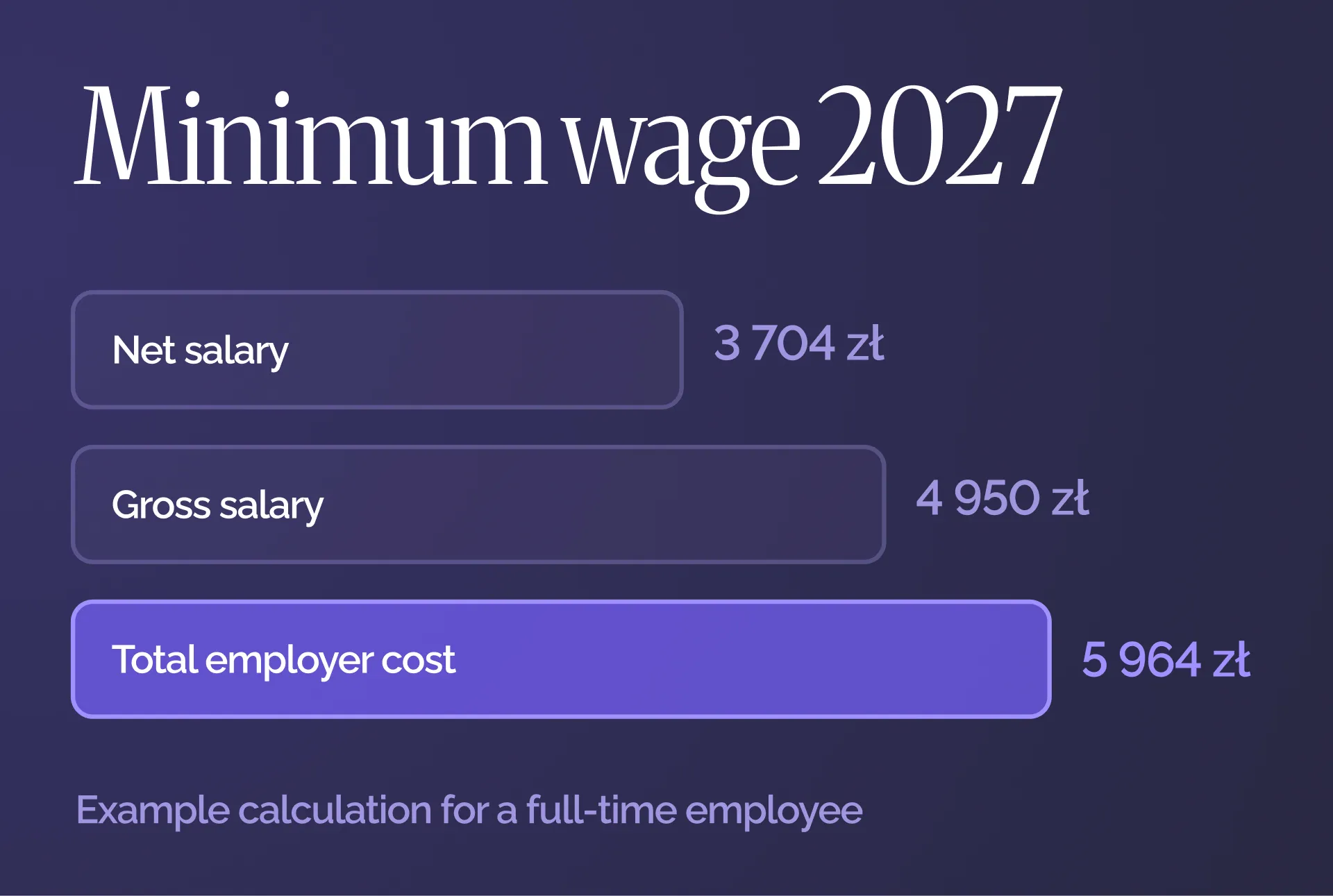
- Micro-debts are allowed: On the day the insured event occurs (childbirth), your total debt to ZUS must not exceed 1% of the minimum wage (in 2026, this limit is 48.06 PLN). If the debt is less than this amount, payments will begin as usual. If the debt exceeds the limit, the right to payment is suspended, but you will have exactly 6 months to pay it off in full, after which ZUS will pay the benefit retroactively.
The Universal Minimum Rule (Kosiniakowe)
Even if you paid minimum contributions, the state will back you up. The Kosiniakowe rule applies: if, after all calculations, the benefit of the insured entrepreneur is below 1,000 PLN net per month, ZUS automatically guarantees a top-up to this amount.
Example: If you paid contributions from the preferential base (Preferencyjny ZUS) for a short time, the calculated benefit amount may be low (e.g., 350 PLN net). In this case, ZUS automatically compensates the difference (650 PLN) from the state budget. This state top-up is completely exempt from income tax (PIT).
Important clarification: This rule applies only to maternity and parental leave and does not apply to paternity leave (urlop ojcowski). You also need to consider taxes: ZUS first calculates the base amount, deducts the tax advance (PIT), and only if the net amount is less than 1,000 PLN does it compensate the difference.
Timeline: 3 Types of Leave for Parents
To maximize financial benefits and time with the child, parents can flexibly combine three types of leave. The state system works as a single mechanism: even if one parent is employed (Umowa o pracę) and the other runs a JDG, you can still share the total quotas between yourselves.
- Maternity Leave (Urlop macierzyński): The primary, basic leave for the mother. It lasts 20 weeks (for the birth of one child) and is granted immediately after the baby is born.
- Parental Leave (Urlop rodzicielski): A shared pool of time (up to 41 weeks) that can be flexibly divided between parents. The exception is the 9 "non-transferable" weeks, which are strictly reserved for the second parent (most often the father).
- Paternity Leave (Urlop ojcowski): A short 14-day leave exclusively for the father. It is paid at a 100% rate and expires when the child turns 1 year old.
Let's take a closer look at each one.
Maternity Leave (Urlop macierzyński)
Maternity leave is the first and mandatory stage of support. Its basic duration depends on the number of children born:
- 1 child: 20 weeks (140 days).
- 2 children (twins): 31 weeks (217 days).
Recommendation: Although the law allows you to start maternity leave 6 weeks before childbirth, financially, this is not the most advantageous decision. It is much more effective to take regular pregnancy sick leave (Zwolnienie lekarskie — code B) prior to the birth. It is paid at a rate of 100% of the base, and all your legal 20 weeks of maternity leave will be preserved for use after the baby is born!
How Benefits Are Calculated: Two Strategies
Payouts are calculated based on your ZUS base for the last 12 months. You have two paths, and the choice depends on how quickly you submit your application to ZUS. To understand the real numbers, it is important to know the current ZUS bases for 2026:
It is from these amounts that the payout percentages will be calculated depending on the strategy you choose:
- Stability Strategy (81.5% rate): If you submit one general application for both leaves (maternity + parental) within 21 days after childbirth, ZUS will pay you 81.5% of your calculated base throughout the year. This is the most popular option, ensuring a steady cash flow.
- Stepped Strategy (100% / 70% rate): If you miss the 21-day deadline or submit applications separately (first for maternity, and half a year later for parental), the first 20 weeks will be paid at a 100% rate, and the subsequent parental leave at a 70% rate.
Parental Leave (Urlop rodzicielski) and the Father's Quota
The right to take parental leave (urlop rodzicielski) arises immediately after the end of maternity leave (or from the moment of the child's birth if the mother does not have insurance). This is a logical continuation of support, but with one fundamental difference: this leave is intended for both parents.
The basic total duration of this leave for the birth of one child in 2026 is 41 weeks (for twins — 43 weeks). According to Work-Life Balance rules, neither parent can claim this entire duration for themselves.
Leave Architecture:
- Maximum for one parent: 32 weeks (this is the absolute maximum a mother or father can take individually).
- Non-transferable quota: 9 weeks. Exclusively reserved for the second parent (most often the father). These weeks cannot be transferred to the mother — if the father declines the leave, they are simply canceled.
- The remaining weeks can be divided between the parents in any proportion or used simultaneously.
Key Conditions of Parental Leave
The mechanics of this leave give entrepreneurs maximum flexibility in planning their time and finances. The following accommodating conditions apply to JDG payers:
- Freedom of timing: The leave does not necessarily have to be taken immediately after maternity leave ends. You can use it at any time up until the end of the calendar year in which the child turns 6.
- Can be split: You are not obligated to take all the weeks in one block. The leave can be divided into a maximum of 5 parts.
- Simultaneous use: Mom and dad can be on parental leave at the same time. For example, you can take a portion of the shared quota and spend a month at home together.
- Legal work: As with maternity leave, while receiving the benefit, you can continue to conduct business operations, manage the company, and issue invoices.
Benefit Amount: The payout amount during parental leave directly depends on the strategy you chose when submitting documents right after childbirth (detailed in the section above).
Special Conditions for an Entrepreneur Father (Dodatkowy rodzicielski)
Returning to the 9 weeks strictly reserved for the father. If the father is also an entrepreneur, the following payout rules apply to him:
- Cannot be transferred to the mother: If the father opts not to take the leave, this period is simply nullified.
- Separate calculation base: The benefit for this period is calculated based on the father's individual ZUS base and amounts to 70% of this base.
- Immediate payouts: There is no need to wait 3 months after setting up voluntary chorobowe insurance; the right is established immediately provided the insurance is active.
- Deadlines: These 9 weeks can be used (in a single block or several parts) until the end of the calendar year in which the child turns 6.
- And yes, the father can continue running his business and issuing invoices during this leave!
Addition: If the mother is insured with ZUS but for some reason did not use her share of the parental leave, the father can claim the main portion for himself (up to 32 weeks). This requires a written statement (oświadczenie) from the mother. Important: If the spouse does not have insurance and receives state aid for mothers (świadczenie rodzicielskie) through MOPS or Urząd, the entrepreneur father will not be able to claim these shared 32 weeks from ZUS. However, his personal non-transferable quota of 9 weeks remains securely his under any circumstances!
Paternity Leave (Urlop ojcowski)
This is a separate entitlement, independent of the mother's maternity leave. Entrepreneur fathers have the right to 14 calendar days of leave, financed at 100% of the father's individual ZUS base.
Key features:
- Strict deadlines: The leave must be utilized strictly before the child reaches 1 year of age (12 months). It can be taken entirely as one block (14 days) or split into two equal halves (7 days each).
- Double benefit: You have the legal right to reduce your ZUS social contribution obligations proportionally to the days of your leave. For "Duży ZUS" payers in 2026, the savings for 14 days will amount to approximately 899 PLN.
- Business doesn't stop: You can continue to sign contracts and issue invoices directly during this leave.
- Taxation (PIT) and exemptions: By default, the paternity leave benefit is subject to standard tax (12% advance), just like other ZUS disbursements. However, you have the opportunity to achieve absolute PIT-0 if you qualify for one of 4 targeted reliefs: you are under 26 (Ulga dla młodych), you have 4 or more children, you qualify for the return relief (repatriation), or you are a working pensioner. In these scenarios, the payout is tax-exempt.
Instructions: Paperwork and ZUS Contribution Optimization
Here we have consolidated all the bureaucratic steps required to properly formalize your payouts.
When transitioning into any of the listed leaves, the state assumes the payment of your social contributions (pension and disability). However, ZUS does not update this data automatically! You must independently update your status within 7 days from the start date of the specific leave. During the benefit period, the entrepreneur is only obligated to pay health insurance (ubezpieczenie zdrowotne).
What to do in ZUS (via the PUE/eZUS platform):
- Temporarily deregister from full social insurances (form ZUS ZWUA).
- Register exclusively for zdrowotne by changing the registration code (form ZUS ZZA).
Legal contribution optimization: Typically, when switching to zdrowotne via the ZZA form, the standard code 05 10 00 is used. But if your benefit is small and the state tops it up to 1,000 PLN under the Kosiniakowe rule, use the special code 05 80 00 (or 05 81 00). This grants you the legal right to skip paying even the health insurance.
What documents to submit for the benefit:
Regardless of who is taking the leave or what kind of leave it is, you will always need:
- ZUS Z-3b (a special income certificate for entrepreneurs (JDG), which serves as the basis for calculating the benefit amount).
- Akt urodzenia dziecka (a copy of the child's birth certificate).
Additionally, append the following depending on the specific leave you are applying for:
- Maternity + Parental (Single application): ZUS ZAM — The unified universal form for maternity benefit applications. This form is used if the mother wishes to declare her intent to take both maternity and parental leave as a single continuous block within 21 days of birth (to lock in the 81.5% rate).
- Maternity Leave only: ZUS ZAM — standard application for urlop macierzyński.
- Parental Leave (for mom or dad): ZUS ZUR — application for urlop rodzicielski. Additionally: if one parent claims the shared portion of the leave (e.g., the father takes 32 weeks instead of the mother), you must attach an Oświadczenie drugiego rodzica (a declaration from the second parent confirming they are not utilizing their share).
- Paternity Leave (14 days): ZUS ZAO — the exclusive application for dads for urlop ojcowski.
Returning to Work
After the leave concludes, the procedure must be repeated in reverse: you need to deregister from zdrowotne (ZWUA) once again and submit form ZUS ZUA to restore your full insurance package. During this process, you have the legal right to proportionally reduce your social contributions for the month in which you were on leave (for instance, for those 14 days of paternity leave).
When you commence maternity leave, your voluntary sickness insurance is canceled automatically. Therefore, when submitting the ZUA form upon returning to work, you are strictly obliged to check the box again to confirm your desire to rejoin the voluntary sickness insurance scheme (dobrowolne ubezpieczenie chorobowe) within 7 days. If you neglect to check this box, your continuity of insurance will be broken, and you will forfeit the right to paid sick leave (L4) in the future.
Contribution Holidays (Wakacje składkowe)
When mapping out maternity leaves, do not overlook the current support mechanism available for micro-entrepreneurs. Once per calendar year, you have the right to select one month of complete exemption from paying social contributions. In 2026, for Duży ZUS payers, this translates to savings of 1,926.76 PLN for the month.
You cannot utilize these contribution holidays during the same month you receive maternity benefits. However, it serves as an ideal strategic asset that can be activated immediately before heading into maternity leave or directly after returning to work. Furthermore, an entrepreneur father can take his 14 days of paternity leave in one month and the contribution holidays in a subsequent month, thereby maximizing the overall financial support extracted from the state.
Disclaimer: This article is for informational purposes only and relies on current ZUS data for 2026. Every entrepreneur's situation is unique, and legal interpretations may evolve. For precise benefit calculations and tailored tax strategy planning, we strongly recommend booking an individual consultation with an accountant.