PKD 2025 in Poland: What JDG and Sp. z o.o. Owners Should Check Before the End of 2026

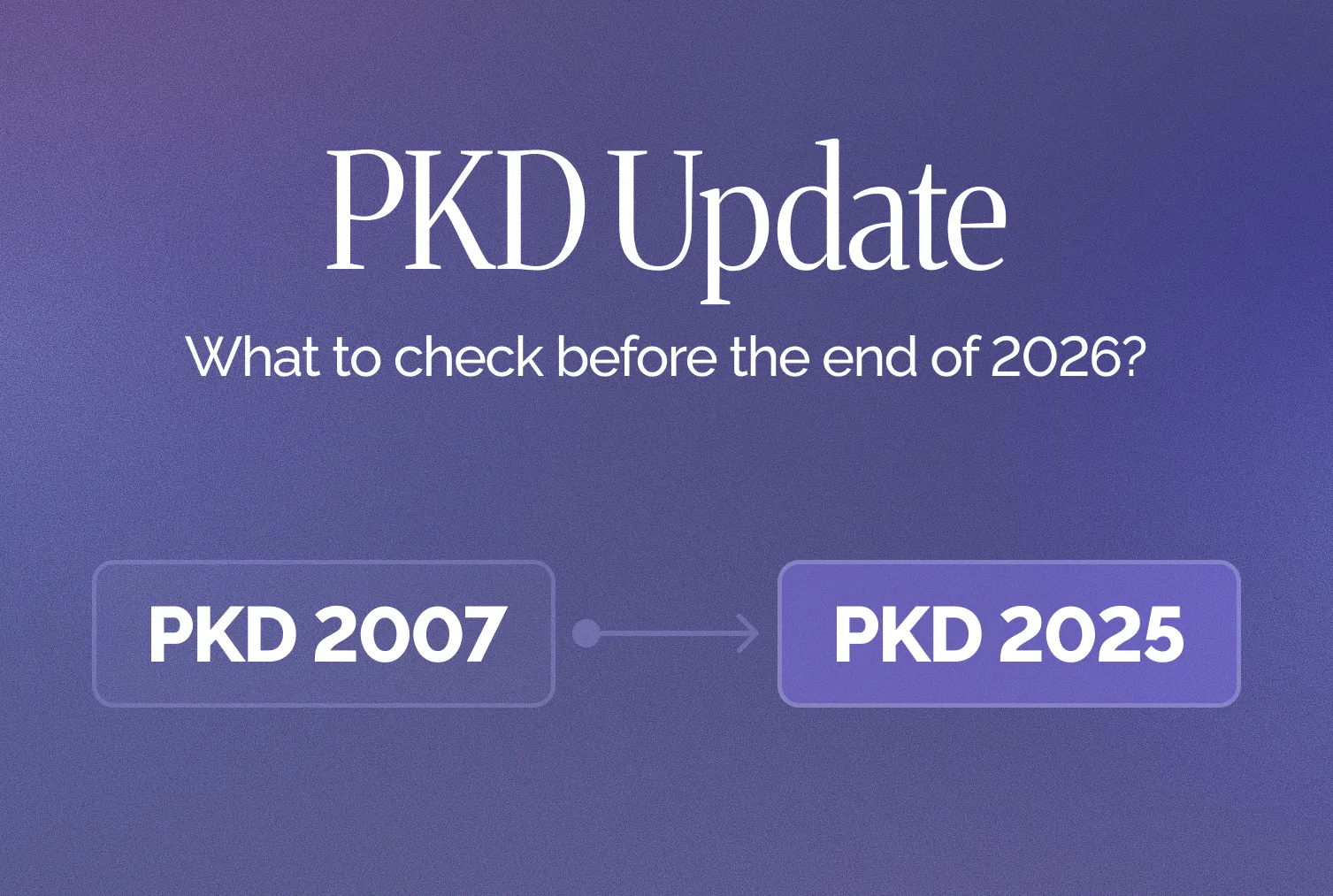
If you registered your business in Poland before 2025, your company records may still contain outdated PKD codes. The transition period ends on 31 December 2026, after which the old codes will begin to be automatically replaced with those from the new classification.
Not every business owner needs to submit an update. However, it's worth checking which new codes will be assigned to your business, as they may not accurately reflect what your company actually does.
What is PKD and what has changed?
PKD (Polska Klasyfikacja Działalności) is the Polish Classification of Business Activities. It is a system of codes used to identify the type of business you operate, such as software development, retail or construction.
Since 1 January 2025, Poland has used a new classification called PKD 2025.
Some older codes have been merged, while others have been divided into several more specific categories. As a result, updating your PKD codes isn't always as simple as replacing one number with another. In some cases, you need to choose between several possible codes.
Who needs to check their PKD codes?
Start by reviewing your business registration:
- Already using PKD 2025? You don't need to update your codes again simply because the transition period is ending. Just make sure they accurately describe your current business activities.
- Still using PKD 2007? Check the new equivalents of all your registered codes, including your main business activity and any additional activities.
These rules apply to both sole proprietorships (JDG — jednoosobowa działalność gospodarcza) and companies registered in the National Court Register (KRS), including Polish limited liability companies (spółka z o.o.).
The transition also applies to suspended sole proprietorships.
However, you may need to update your codes before the end of the year.
If you submit an application to change your CEIDG registration, you must update your PKD codes at the same time — even if you're only changing your business address.
For companies registered in KRS, the rules are different. An earlier PKD update is required when changing the registered scope of business activities, not every time company details are amended.
Why should you check your PKD codes before the deadline?
If each of your old PKD codes has one clear equivalent in the new classification, you can wait for the automatic update and check the result afterwards.
The situation is more complicated when one old code corresponds to several new ones.
In that case, the system will select a code based on the official conversion table published by Statistics Poland (GUS). It will not individually check which services your business provides or which products you sell.
For example, the old code 47.91.Z covered retail sales via the internet and mail order.
Under PKD 2025, this activity has been divided into multiple categories. However, the automatic conversion rules assign it to 47.71.Z — Retail sale of clothing.
For an online shop selling other products, this may be the wrong classification.
If your current code has several possible equivalents, it's better to choose the ones that accurately reflect your activities and update your registration before the end of December.
What happens if you don't update your PKD codes?
For businesses registered in CEIDG, the automatic conversion is expected to be completed by 31 January 2027, provided the system can assign the new codes.
Automatic conversion is also planned for companies registered in KRS after the transition period ends.
This means not every business record will necessarily be updated on 1 January 2027.
However, there is an important exception.
If your CEIDG registration contains missing or invalid PKD codes, don't rely on automatic conversion.
You should correct or complete this information by 31 December 2026.
If the system cannot assign valid new codes, the regulations provide for the business entry to be removed from CEIDG after 31 January 2027.
How to check and update your PKD codes
First, find your business in CEIDG or obtain a current extract from KRS.
Check which PKD codes are registered and whether they belong to the 2007 or 2025 classification.
You can find the official conversion tables and explanations in the PKD 2025 materials published by Statistics Poland (GUS).
Read the descriptions of the relevant codes carefully. A code's title alone may not tell you whether it covers the services or products your business offers.
If you operate a sole proprietorship (JDG)
Submit a CEIDG-1 application to update your business registration.
You can do this online through Biznes.gov.pl or submit a paper application at any municipal office (urząd gminy) in Poland.
Updating your CEIDG registration is free of charge.
You don't need to separately notify the tax office, GUS or ZUS (Poland's Social Insurance Institution) about the change. The updated information will be forwarded automatically.
Once your application has been processed, check your registration to make sure the correct codes appear.
If you operate a limited liability company (spółka z o.o.)
Changes to a company's PKD codes must be submitted electronically to KRS, the Polish National Court Register.
Before submitting the application, compare the new codes with the scope of business activities stated in your company's articles of association.
Updating PKD codes doesn't always require changes to the company's articles.
However, if you want to add a business activity that isn't covered by the existing articles, you'll need to amend them first.
Companies established using the S24 template may also need to amend their articles when updating PKD codes, even if their actual business activities remain unchanged.
An application solely to replace old PKD codes with new ones, submitted by 31 December 2026, is exempt from the court filing fee.
This exemption doesn't necessarily apply to other company changes submitted at the same time.
Will changing your PKD codes affect your taxes?
Changing a PKD code doesn't automatically change your tax rate.
For example, under Poland's lump-sum tax system (ryczałt), the applicable rate generally depends on the services you actually provide and their classification under PKWiU (the Polish Classification of Products and Services), rather than solely on the PKD code in your registration.
If you're changing not only your codes but also the actual scope of your business activities, it's worth discussing the potential tax implications with your accountant.
If you're unsure whether your PKD codes need updating, contact ELP Office for a free initial consultation. Our team can help you understand what to check before submitting changes.
We provide support in English, Polish, Ukrainian, Russian and Turkish.
This article is for general information purposes only and does not constitute individual legal advice.