W-8BEN for Freelancers and Entrepreneurs in Poland: What It Is and How to Complete It

If you live and work in Poland but cooperate with a U.S. company, client, platform, or broker, you may be asked to complete Form W-8BEN.
Its name sounds more complicated than the form itself. W-8BEN is primarily used to confirm to a U.S. payer that you are a foreign beneficial owner of the income.
In certain cases, the form also allows you to claim benefits under an international tax treaty and apply a reduced rate of withholding tax or an exemption from it.
What Is Form W-8BEN?
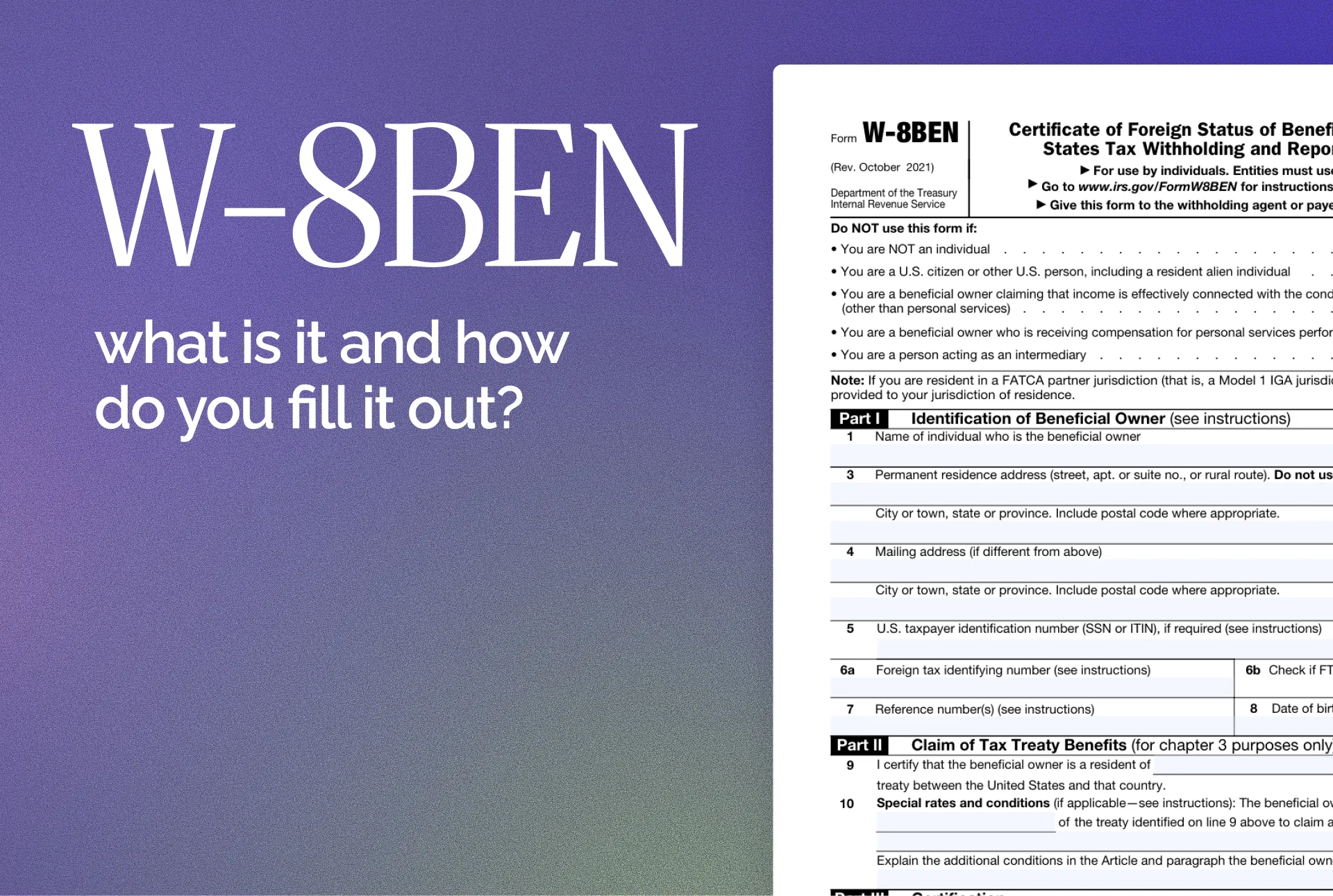
The document’s full name is Certificate of Foreign Status of Beneficial Owner for United States Tax Withholding and Reporting (Individuals).
W-8BEN is intended for individuals and is used to certify their foreign status to a U.S. payer or financial institution.
Where applicable to a particular type of income, a properly completed form also allows the individual to claim benefits provided under an international tax treaty.
Important: you do not submit Form W-8BEN directly to the IRS. It should be provided to the organization that requested it, such as a U.S. client, broker, bank, or payment platform.
Who May Need Form W-8BEN?
The form is commonly requested from people who live in Poland and receive payments connected with the United States. This may include freelancers and owners of sole proprietorships, known in Poland as JDG, who work with U.S. clients; authors and digital content creators; recipients of royalties; investors holding U.S. securities; and users of certain international platforms.
However, the reason for completing the form will depend on the type of income received.
Form W-8BEN is not intended for Polish limited liability companies, such as a sp. z o.o., or other legal entities. Foreign companies in similar situations generally use Form W-8BEN-E.
Do I Have to Pay U.S. Tax If My Client Is American?
Not necessarily. If an entrepreneur lives and works in Poland and provides services to a U.S. client from Poland, the fact that the client is based in the United States does not usually mean that 30% U.S. tax must be withheld from the payment.
However, the U.S. client may still request Form W-8BEN to confirm that the contractor is a foreign beneficial owner of the income.
The rules may be different if the work is physically performed in the United States or if the payment concerns another type of income, such as dividends or royalties. In such cases, the type of income, tax residency, and the provisions of the tax treaty between Poland and the United States must be considered.
There is therefore no universal rule that “W-8BEN reduces the tax rate from 30% to 15%.” The applicable rate and tax treatment depend on the specific circumstances.
How to Complete Form W-8BEN
The form consists of three parts: identification of the beneficial owner, a claim for tax treaty benefits, and certification of the information provided.
You can download the form from the official IRS website: https://www.irs.gov/pub/irs-pdf/fw8ben.pdf
Part I — Identification of Beneficial Owner
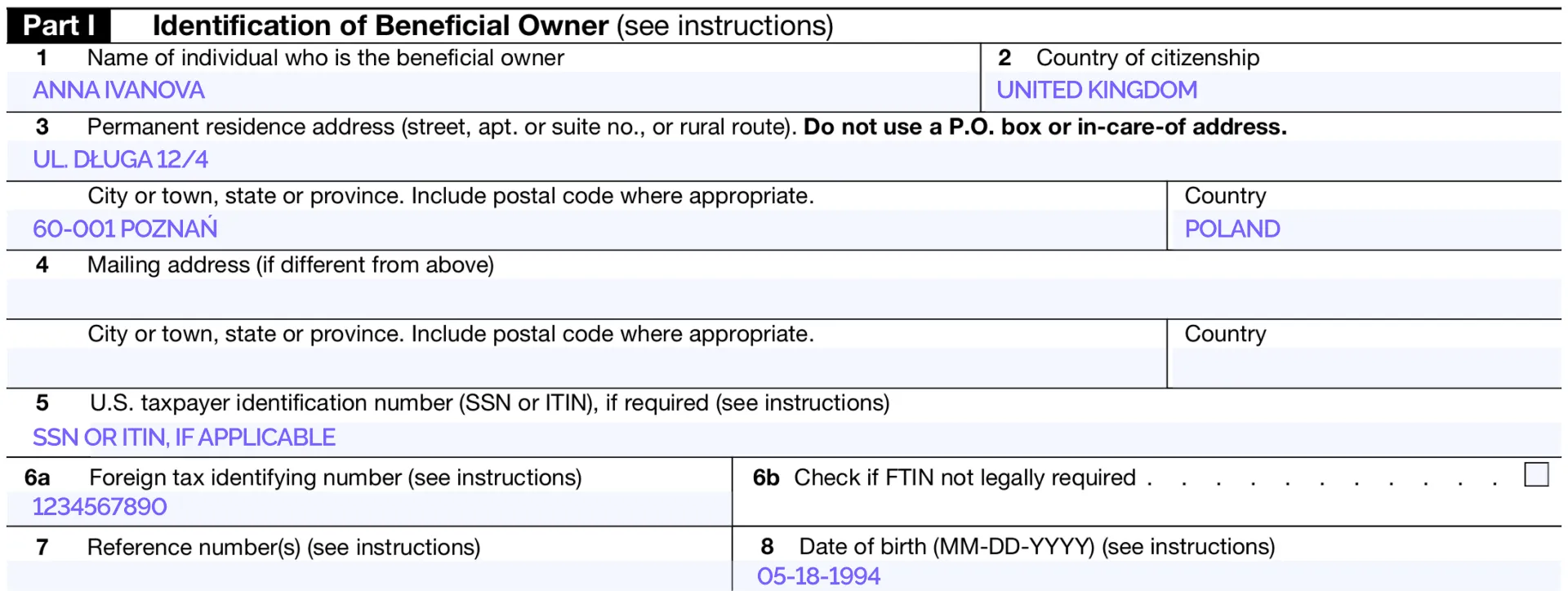
Line 1 — Name of individual who is the beneficial owner
Enter your first and last name.
Line 2 — Country of citizenship
Enter your country of citizenship.
Line 3 — Permanent residence address
Enter your permanent residence address in the country where you are a tax resident. Do not use a P.O. box or an address used only for receiving correspondence.
Line 4 — Mailing address
Complete this field if your mailing address is different from the address entered in Line 3.
Line 5 — U.S. taxpayer identification number
Enter your U.S. SSN or ITIN if you have one and it is required in your situation.
In many typical cases, a Polish entrepreneur working from Poland does not need to obtain an ITIN specifically for this purpose. However, the requirements depend on the type of income and the tax treaty benefit being claimed.
Line 6a — Foreign tax identifying number
Enter your foreign tax identification number, or FTIN.
In Poland, the relevant identifier may be a NIP or PESEL number. An owner of a JDG should use their NIP. PESEL is primarily used as a tax identifier by individuals who do not conduct business activity and do not fall into another category of taxpayers required to use NIP.
Line 6b — FTIN not legally required
Check this box if the law of your country of tax residence does not require you to have a foreign tax identification number. If you have a Polish NIP or PESEL number, this box is generally left unchecked.
Line 7 — Reference number
This field is optional. You may enter an account number, client number, or another identifier if requested by the client or platform.
Line 8 — Date of birth
Enter your date of birth in MM-DD-YYYY format. For example, May 18, 1994 should be entered as 05-18-1994.
Part II — Claim of Tax Treaty Benefits
Complete this part if you are claiming benefits under a tax treaty between the United States and your country of tax residence.
Line 9 — enter the country in which you are a tax resident for the purposes of the treaty. If you are a tax resident of Poland, enter Poland.
Line 10 is not always required. Complete it if claiming a particular benefit requires you to specify the relevant tax treaty article, type of income, applicable rate, or fulfillment of additional conditions.
Do not copy information into Line 10 from someone else’s example. The content of this field depends on the type of income and the specific treaty benefit you are claiming.
If you are not claiming tax treaty benefits, you may leave Part II blank. Form W-8BEN can still be used to certify your foreign status. The IRS explicitly states that the form should be provided to the payer regardless of whether the individual is claiming a reduced rate of withholding or an exemption.

Part III — Certification
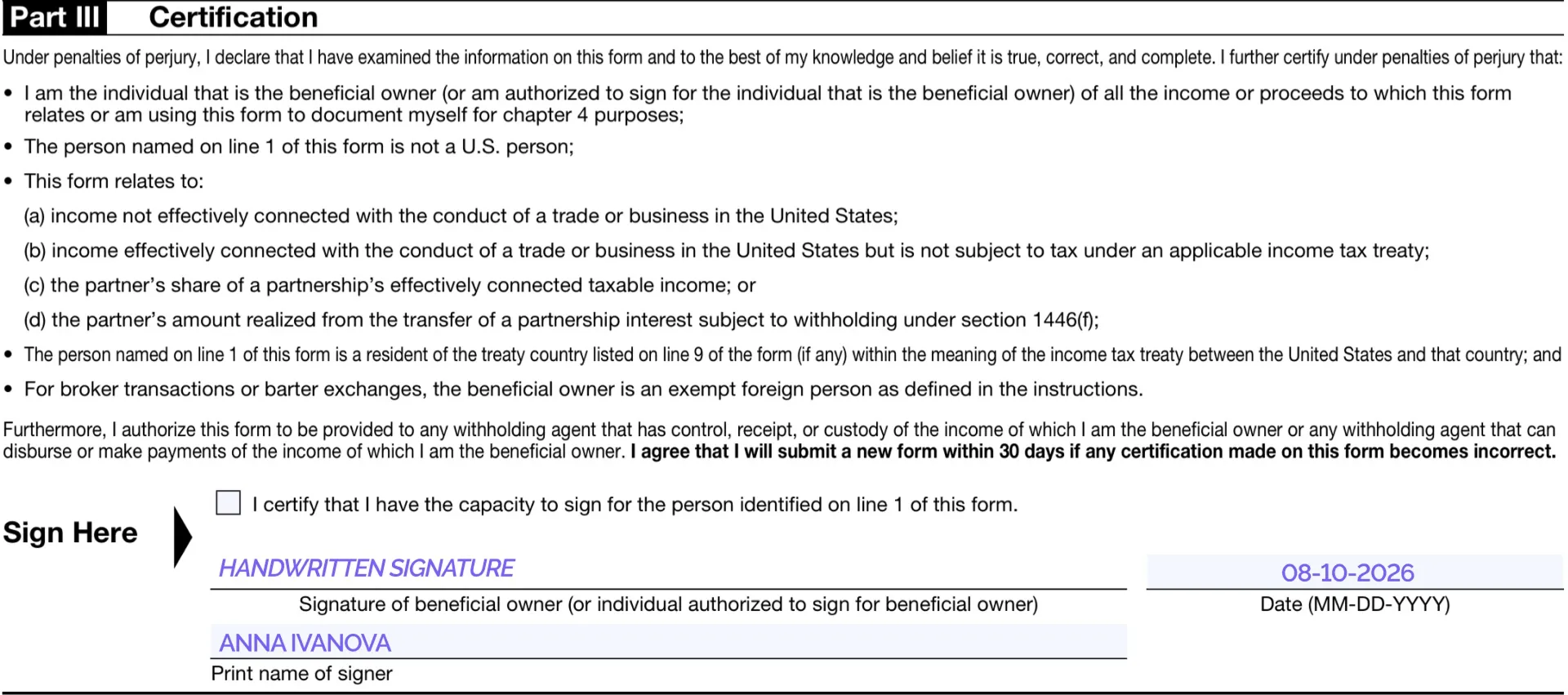
In the final part, you certify that the information provided on the form is correct and complete.
If you are completing Form W-8BEN yourself, you must provide:
Signature of beneficial owner — sign the form. If you are completing a paper form, provide a handwritten signature.
Date — enter the date in MM-DD-YYYY format.
Print name of signer — print the first and last name of the person signing the form.
If the form is signed by an authorized representative, that person must have the appropriate authority and check the box stating, “I certify that I have the capacity to sign…”. Where required, a power of attorney or a copy of it should be attached to the form.
Important: Form W-8BEN may be signed electronically if the organization receiving the form accepts electronic signatures. Simply typing a name in the Signature field is not sufficient. The electronic signature must make it possible to confirm that the document was genuinely signed by an authorized person.
How Long Is Form W-8BEN Valid?
Form W-8BEN is generally valid from the date it is signed until December 31 of the third calendar year following the year in which it was signed.
For example, if the form is signed in September 2026, it will generally remain valid until December 31, 2029.
If your circumstances change and the information provided on the form becomes incorrect, you must submit a new Form W-8BEN within 30 days. This may be necessary, for example, if your tax residency changes.
Common Mistakes When Completing Form W-8BEN
One of the most common mistakes is assuming that having a U.S. client automatically means that the payment is U.S.-source income. For services, the IRS generally considers where the work is physically performed.
Another mistake is entering a PESEL number as the Foreign TIN despite operating a JDG. For a Polish entrepreneur, the relevant tax identification number is generally NIP.
Citizenship and tax residency are also commonly confused. Line 2 asks for citizenship, while eligibility for treaty benefits in Part II depends on tax residency.
Another mistake is using Form W-8BEN for a sp. z o.o. or another company that is a legal entity. Form W-8BEN-E is intended for foreign legal entities.
Finally, do not copy a tax treaty article or withholding rate from someone else’s example. Dividends, royalties, and payments for services are subject to different tax rules.
Do I Have to Pay Tax in Poland After Completing Form W-8BEN?
Form W-8BEN primarily concerns U.S. withholding and reporting rules. It does not replace tax reporting in Poland.
If you are a Polish tax resident or operate a JDG in Poland, income received from a foreign client must be properly recorded in your Polish accounts and taxed according to your chosen form of taxation and the nature of the transaction.
If tax was withheld abroad, you must also determine how the rules for eliminating double taxation apply.
Form W-8BEN should therefore not be treated as a “tax return.” It is a document that helps the U.S. payer correctly determine your status and the applicable withholding rules.
What Should You Do If a U.S. Client Sends You Form W-8BEN?
A request to complete the form is standard practice and does not mean that you have a tax problem.
Before completing it, check three things: where you are a tax resident, what type of income you receive, and where the work is physically performed.
If you operate a JDG in Poland and are unsure which tax identification number to provide, whether you should complete Part II, or how to account for payments from a U.S. client in your Polish bookkeeping, ELP Office can review your situation and help you handle the accounting correctly.
This material is provided for informational purposes only and does not constitute individual legal, tax, or accounting advice. We recommend consulting an appropriate specialist regarding your particular circumstances.