Taxes
Wakacje składkowe 2026: how a sole proprietor can avoid paying ZUS social contributions for one month
What is wakacje składkowe?
Wakacje składkowe allows an entrepreneur to receive an exemption from paying their own social contributions for one selected month of the year.
During that month, the entrepreneur:
- continues operating the business;
- may earn income;
- issues invoices as usual;
- remains registered with ZUS;
- maintains social insurance coverage.
The exempted contributions are paid from the state budget. Therefore, the month covered by wakacje składkowe is taken into account when future pension and social insurance rights are calculated.
Applications have been accepted since 1 November 2024. The first exemption was available for December 2024. As of July 2026, the main eligibility rules remain largely unchanged. Most updates have concerned the technical structure of the RWS form and the information required for de minimis aid.
Wakacje składkowe should not be confused with zawieszenie działalności. When using the relief, the business continues to operate. When business activity is suspended, the entrepreneur temporarily stops normal commercial activity.
Eligibility conditions
Who can use wakacje składkowe?
The relief is primarily intended for entrepreneurs operating a jednoosobowa działalność gospodarcza and registered in CEIDG.
A partner in a spółka cywilna may also use the relief, but the application concerns the partner’s personal contributions and must be submitted through their individual payer account.
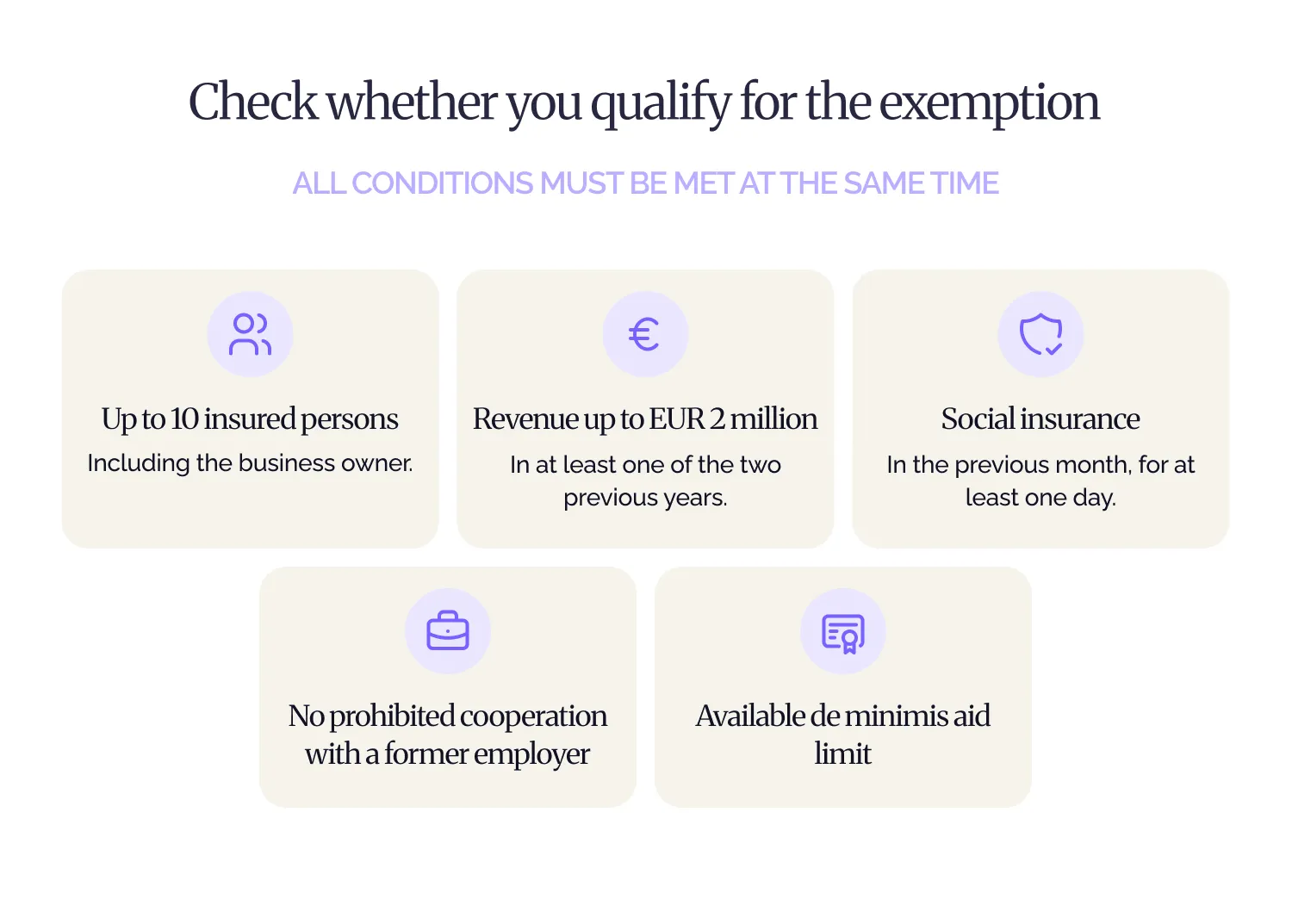
Several conditions must be met at the same time.
1. No more than 10 insured persons
In the month preceding the month in which the application is submitted, the entrepreneur must have no more than 10 insured persons registered with ZUS.
The entrepreneur is included in this limit. In a standard situation, this means the entrepreneur and no more than nine other insured persons.
The calculation may include:
- employees;
- zleceniobiorcy;
- osoby współpracujące;
- the entrepreneur.
A person registered for at least one day during the relevant month may be included. The calculation is not based only on the situation on the final day of the month.
For example, a person working under a short-term umowa zlecenie may still count toward the limit.
Students and pupils under the age of 26 working under an umowa zlecenie who are not subject to ZUS insurance are not included. Other exceptions may also apply, so borderline cases should be checked individually.
2. Revenue limit
The entrepreneur must meet the annual revenue requirement.
The relief is available if, in at least one of the two calendar years preceding the year of the application:
- annual revenue did not exceed the equivalent of EUR 2 million; or
- the entrepreneur did not receive any business revenue.
For an application submitted in 2026, the relevant years are 2024 and 2025. It is sufficient to meet the condition in one of those years.
3. No prohibited work for a former employer
The relief may be unavailable if the entrepreneur provides services to a former employer and performs the same duties that were previously performed under an employment contract in the year the business activity began or in the preceding year.
The cooperation is assessed for:
- the calendar year preceding the RWS application;
- the current calendar year up to the date of application.
The actual nature of the work is important, not only the title of the position or the wording of the contract.
Therefore, when moving from an umowa o pracę to B2B cooperation with the same employer, the previous duties should be carefully compared with the current scope of services.
4. Social insurance in the preceding month
The entrepreneur must have been subject to pension, disability and accident insurance for at least one day in the month preceding the RWS application.
There is no separate minimum period for operating a JDG. However, a newly established business may not always be able to use the relief immediately.
For example, if the JDG was registered on 1 May, the entrepreneur was subject to social insurance in May and submitted the RWS application in June, July may be selected as the exemption month, provided that all other requirements are met.
5. Available de minimis aid limit
Wakacje składkowe constitutes de minimis state aid. Before submitting the application, the entrepreneur should verify that the available de minimis aid limit has not been exhausted.
Who cannot use the relief?
The exemption will not be granted if the entrepreneur:
- exceeds the insured-person limit;
- does not meet the revenue requirement;
- performs prohibited work for a former employer;
- was not subject to social insurance in the preceding month;
- has exhausted the de minimis aid limit;
- has already used wakacje składkowe in the current calendar year;
- submits the application outside the permitted period.
The relief is not available during ulga na start because the entrepreneur is not subject to the required social insurance during that period.
It may become available after moving to preferencyjne składki or another contribution scheme, provided that the remaining requirements are met.
Which contributions are covered and how much can you save?
Which contributions are covered?
The exemption applies only to the entrepreneur’s own social contributions.
It may cover pension, disability and accident insurance contributions, as well as voluntary sickness insurance and contributions to Fundusz Pracy and Fundusz Solidarnościowy where applicable.
Voluntary sickness insurance is covered only if the entrepreneur was subject to this insurance for at least one day both in the month of submitting the RWS application and in the preceding month.
The most important limitation is that składka zdrowotna is not covered by wakacje składkowe. It must still be calculated and paid under the standard rules.
Contributions for employees and other insured persons, taxes and previous ZUS arrears also remain payable.

How much can you save in 2026?
The amount saved depends on the entrepreneur’s social contribution scheme.
Based on the 2026 rates, the estimated exemption amount is shown in the table below.
Składka zdrowotna must be paid separately.
The minimum monthly health contribution for the period from February 2026 to January 2027 is PLN 432.54 where the applicable taxation method and calculation base do not result in a higher amount.
The actual saving will therefore differ between entrepreneurs. It depends on:
- the social contribution base;
- whether voluntary sickness insurance is paid;
- whether Fundusz Pracy and Fundusz Solidarnościowy apply;
- the entrepreneur’s ZUS contribution scheme.
When and how to submit an RWS application
Which month can be selected?
The entrepreneur may select one exemption month in each calendar year.
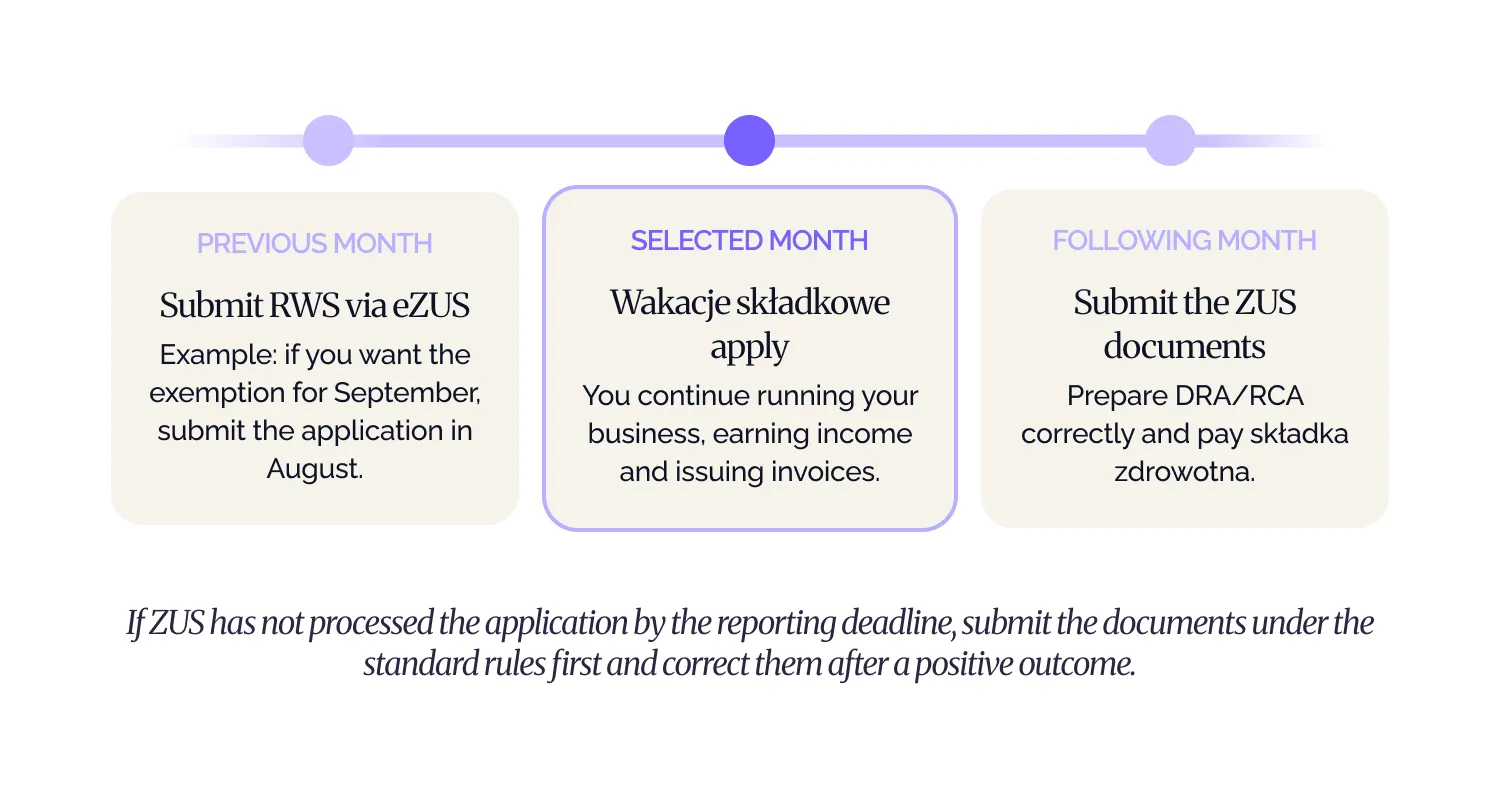
The RWS application must be submitted in the month immediately preceding the selected exemption month.
For example:
The application cannot be submitted retroactively or several months in advance.
For example, to receive the exemption for August, the entrepreneur must submit the application in July. An application submitted in August may only concern September.
This is one of the most important rules. ZUS may leave an application without consideration if it is submitted outside the permitted month.
How to submit an RWS application through eZUS
The application must be submitted electronically through the konto płatnika in eZUS.
Before starting, prepare information about any de minimis aid received during the previous three years and check your main PKD code. Official certificates will only be required if you choose to confirm the aid through zaświadczenia.
Step 1. Log in to eZUS
Log in to eZUS and go to Konto płatnika.
The application must be submitted from the payer profile.
A wspólnik spółki cywilnej submits RWS through their individual konto płatnika, not through the company’s profile.
Step 2. Find the RWS form
In the side menu, select Katalog usług.
Then find:
Złóż wniosek o zwolnienie z obowiązku opłacenia składek za wskazany miesiąc (RWS)
Select Przejdź do usługi to open the application.
Step 3. Select the purpose and verify the details
For the first application, select Wniosek.
The entrepreneur’s details will be loaded automatically. Check them and complete any required fields that are missing.
Until ZUS reviews the application, it may be corrected or withdrawn using:
- Uzupełnienie/korekta wniosku;
- Wycofanie wniosku.
Step 4. Check the exemption month
In the Treść wniosku section, the system automatically displays the month following the month in which the application is submitted.
For example, if the RWS form is completed in August, it will concern September.
The month cannot be changed manually.
Step 5. Complete the Oświadczenia section
On this screen, two matters must be confirmed.
First, confirm that the revenue requirement is met: in at least one of the two preceding calendar years, revenue did not exceed the equivalent of EUR 2 million, or no business revenue was received.
Second, indicate whether de minimis aid was received during the previous three years.
If no aid was received, select:
Nie korzystałem z pomocy publicznej de minimis
If aid was received, select:
Korzystałem z pomocy publicznej de minimis
Then select how the aid will be confirmed:
- Oświadczenie — complete the information about the entities from which de minimis aid was received;
- Zaświadczenia — attach the official certificates at the end of the application.
Step 6. Complete the business information
Select the actual size of the enterprise. For many small JDG businesses, the appropriate option will be mikroprzedsiębiorstwo.
Next, choose the classification version in the Wersja PKD field:
- PKD 2007;
- PKD 2025.
Then select the main activity code corresponding to the information registered in CEIDG.
Until 31 December 2026, the application allows PKD 2007 or PKD 2025. After that date, PKD 2025 will be required.
The form will also ask additional questions concerning:
- links with other enterprises;
- mergers, divisions or business transformations;
- activity in agriculture, fisheries or aquaculture.
For a standard JDG that is not linked to other companies, has not undergone a reorganisation and does not operate in these sectors, the usual answer is NIE.
If TAK is selected, the form will request additional information.
Step 7. Add attachments
If Zaświadczenia was selected in the de minimis section, attach the official certificates confirming the aid received.
If Oświadczenie was selected, the relevant information is completed directly in the application and separate certificates are not required.
Step 8. Check the application
At the Podsumowanie stage, open Widok danych dokumentów.
Check:
- the entrepreneur’s details;
- the exemption month;
- information about de minimis aid;
- enterprise size;
- PKD version and code;
- attachments.
If an error is found, return to the previous section and correct it.
Step 9. Sign and submit RWS
Select Podpisz i wyślij, choose one of the available signature methods and submit the application.
After submission, the application status and new ZUS messages can be checked in Sprawy płatnika.
A notification about a new document may also be sent to the email address or telephone number registered in eZUS.
Can the application be corrected or withdrawn?
Until ZUS reviews the application, it may be supplemented, corrected or withdrawn through the RWS form.
The selected exemption month cannot be changed. In that situation, the application must be withdrawn and a new one submitted within the permitted period.
Once the application has been reviewed, it can no longer be corrected or withdrawn through this procedure.
What happens after submission?
If ZUS grants the exemption in full, a separate administrative decision may not be issued. Information about the relief will appear in eZUS.
ZUS will issue an administrative decision if it:
- refuses the exemption;
- grants it only partially;
- later determines that the eligibility conditions were not met.
Receiving the relief does not remove ZUS reporting obligations
Wakacje składkowe exempts the entrepreneur from their own social contributions for the selected month, but it does not remove the obligation to submit settlement documents.
For the exemption month, the entrepreneur must correctly prepare ZUS DRA and, where required, ZUS RCA.
Składka zdrowotna remains payable.
If ZUS has not reviewed the RWS application by the reporting deadline, the entrepreneur should not omit the declaration. The documents should first be submitted under the standard rules and then corrected after the exemption is granted.
It is advisable to inform the accountant in advance about the month selected for wakacje składkowe. This makes it easier to submit the application on time and settle the reporting period correctly.
Insurance, taxes and other reliefs
Does the insurance record remain continuous?
Wakacje składkowe does not create a break in social insurance.
The contributions for the exemption month are financed by the state and are taken into account when future pension and disability benefits are calculated.
Continuity of social insurance rights is also maintained, provided that the general eligibility requirements for the relevant benefits are met.
This is different from ulga na start, during which social contributions are not paid and the corresponding social insurance rights do not arise.
How does the relief affect taxes?
The social contributions, Fundusz Pracy and Fundusz Solidarnościowy amounts covered by the exemption are not subject to PIT.
At the same time, they cannot be treated as a tax-deductible expense because the entrepreneur did not pay them from their own funds.
Składka zdrowotna is calculated and treated under the standard rules applicable to the entrepreneur’s chosen taxation method.
Wakacje składkowe and other reliefs
Wakacje składkowe may be combined with:
- preferencyjne składki;
- Mały ZUS Plus.
The entrepreneur must still meet the general wakacje składkowe requirements.
The relief is not available during ulga na start because the entrepreneur is not subject to the required social insurance during that period.
Common mistakes
Submitting the application in the wrong month
RWS may only be submitted in the month directly preceding the exemption month. It cannot be submitted retroactively or two months in advance.
Incorrectly counting insured persons
Entrepreneurs sometimes count only permanent employees or check the situation only on the last day of the month.
However, a person insured for even one day may be included in the limit.
Assuming that nothing is payable
Składka zdrowotna, employee contributions and taxes remain payable.
Failing to verify de minimis aid
Incomplete or incorrect information may result in a request for additional documents, refusal of the relief or its later cancellation.
Waiting for the result and failing to submit DRA/RCA
If ZUS has not reviewed the application by the reporting deadline, the documents must be submitted under the standard rules and corrected later.
Failing to verify chorobowe coverage
Dobrowolne ubezpieczenie chorobowe is covered only if the entrepreneur was subject to it for at least one day in both the month of application and the preceding month.
Failing to analyse work for a former employer
ZUS assesses the duties actually performed, not only the wording of the contract.
If ZUS later determines that the requirements were not met, the exemption may be cancelled. The entrepreneur may then have to pay the contributions together with interest.
Frequently asked questions
Is it necessary to suspend the JDG?
No. During wakacje składkowe, the entrepreneur may continue working, earning income and issuing invoices.
Is składka zdrowotna still payable?
Yes. The exemption does not cover the health contribution.
Are employee contributions covered?
No. The relief only applies to the entrepreneur’s own contributions.
Is the relief available with preferencyjny ZUS?
Yes, provided that the general conditions are met. The saving will be lower because the social contributions are already reduced.
Is the relief available with Mały ZUS Plus?
Yes, if the entrepreneur meets both the wakacje składkowe requirements and the requirements of Mały ZUS Plus.
Can wakacje składkowe be used during ulga na start?
No. During ulga na start, the entrepreneur is not subject to the social insurance required for wakacje składkowe.
Can the application be submitted retroactively?
No. RWS must be submitted in the month preceding the selected exemption month.
Is a new application required every year?
Yes. A separate RWS application must be submitted for the selected month in each calendar year.
Can RWS be withdrawn?
Yes, but only until ZUS reviews the application.
Will there be a break in the insurance record?
No. The exempted contributions are financed by the state, so continuity of social insurance is maintained.
Summary
Wakacje składkowe allows an entrepreneur to reduce the cost of their own social contributions once per year without suspending business activity.
However, it is not an automatic “month without ZUS”. To use the relief, the entrepreneur must:
- verify the eligibility requirements;
- select the exemption month;
- submit RWS in the preceding month;
- provide the required de minimis information;
- continue paying składka zdrowotna;
- correctly prepare DRA and RCA.
Particular attention should be paid to the application deadline, the insured-person limit and cooperation with a former employer. An error in any of these areas may result in refusal or later cancellation of the relief.
Planning to use wakacje składkowe? ELP Office specialists can help verify the conditions, prepare the RWS application and correctly reflect the exemption in ZUS settlements.

Tax Reliefs 2026: Key Tax Exemptions for Business and Expats
Relocation Relief (Ulga na powrót)
- For whom: Foreigners who have recently moved their center of vital interests to Poland. Available to both employees (umowa o pracę, umowa zlecenie) and sole traders (JDG) under any form of taxation.
- What it provides: Exempts income up to 85,528 PLN per year from income tax (PIT). The relief can be used for 4 consecutive years, giving a total of up to 342,112 PLN of tax-free income.
- Important for foreigners: You must become a tax resident of Poland strictly after December 31, 2021. To obtain the relief, the tax office (Urząd Skarbowy) will absolutely require a certificate of tax residency from your previous country of residence for the 3 years prior to moving.
Relief for the Youth (PIT-0 up to 26 years old) and the B2B Trap
- For whom: Individuals under 26 years of age working as employees (umowa o pracę, umowa zlecenie).
- What it provides: Full exemption from income tax (0% rate) for income up to 85,528 PLN per year.
- Important nuance: This limit is cumulative for all reliefs in the "Zero PIT" group (for return, for 4+ families, for seniors). If you use several bases simultaneously, the total amount of tax-free income will still not exceed 85,528 PLN.
- B2B: The relief categorically does not apply to income from sole proprietorships (JDG). When switching to a B2B contract, the right to PIT-0 is lost instantly, regardless of the form of taxation.
Family Reliefs: Support for Parents
Poland actively supports families, and for foreigners, this is a great way to reduce the amount of tax payable.
Child Relief (Ulga prorodzinna)
- For whom: Parents on the general tax scale (Skala podatkowa).
- Income limits: With one child — up to 112,000 PLN per year per family. If there are two or more children, there is no income limit. Important update: The income limit (112k) is completely abolished if the child has a disability — the deduction is available at any income level.
- What it provides (deduction directly from tax):
- 1st and 2nd child — 1,112.04 PLN per year each;
- 3rd child — 2,000.04 PLN;
- 4th and subsequent — 2,700.00 PLN.
- Limitation: Entrepreneurs on flat tax (Liniowy) or lump-sum tax (Ryczałt) cannot apply this deduction to their business income.
Relief for Large Families (Ulga 4+)
- For whom: Parents raising four or more children.
- What it provides: Tax exemption for income up to 85,528 PLN per year for each parent.
- Important for business: Unlike the standard child relief, Ulga 4+ is available for JDG entrepreneurs (works on the general tax scale, flat tax, and Ryczałt).
Tax Reliefs for the IT Sector
For programmers and engineers, Poland remains one of the most beneficial jurisdictions in Europe.
Innovation Relief (IP Box)
- For whom: B2B entrepreneurs (JDG) creating software code or other intellectual property.
- What it provides: Reduction of the tax rate to 5% on income from the commercialization of intellectual property rights.
- Status for 2026: The relief is maintained in its previous form. The requirement to hire at least three employees, which was discussed in the government, has not come into force. IT specialists can still use the 5% rate as sole traders, provided they follow accounting rules.
Research and Development Relief (Ulga B+R)
- For whom: Companies and entrepreneurs engaged in creating innovations.
- What it provides: Allows an additional deduction of 200% of qualified employee salary costs from the tax base.
- Super bonus: IP Box and Ulga B+R can be legally combined for a single project, reducing taxes to an absolute minimum.
Individual Retirement Account (Ulga na IKZE) — Protection from High Taxes and Savings
- For whom: Entrepreneurs on the general scale (skala podatkowa) whose income approaches the 120,000 PLN threshold (after which the tax increases to 32%).
- What it provides: Contributions to IKZE are fully deductible from the tax base. Contributing the maximum amount can return up to 5,426 PLN of overpaid tax.
- Important for business: In 2026, the contribution limit for JDG entrepreneurs is a record 16,956 PLN.
Everyday Deductions for Business and Life
Internet Relief (Ulga na Internet)
- For whom: All taxpayers paying for network access.
- What it provides: Allows reducing income by up to 760 PLN per year per person (1,520 PLN for spouses) for data transmission payments.
- Important nuance: The relief applies strictly during two consecutive years, after which the right to it is irretrievably lost.
Payment Terminal Relief (Ulga na terminal płatniczy)
- For whom: Entrepreneurs using payment terminals for cashless settlements with clients.
- What it provides: A deduction from 1,000 to 2,500 PLN per year depending on your status. An excellent way to compensate for digitalization costs.
Real Estate and Investments
Thermo-modernization Relief (Ulga termomodernizacyjna)
- For whom: Owners of single-family residential buildings already in use.
- What it provides: A large deduction of up to 53,000 PLN (up to 106,000 PLN for married couples) for eco-modernization: installation of solar panels, heat pumps, window replacement, and insulation.
- Important for foreigners: The tax office requires flawless documentation — the right to the deduction is confirmed only by personalized VAT invoices from legal Polish contractors.
Historic Monuments Relief (Ulga na zabytki)
- For whom: Owners of historic real estate entered into the register of monuments (rejestr zabytków).
- What it provides: The right to deduct 50% of the expenses for conservation, restoration, or construction works from the tax base.
- Important change: Since 2023, the deduction for the mere fact of purchasing the property (for acquisition) has been abolished. Now the relief applies only to actually incurred and documented repair expenses.
- Condition: To apply the relief, you must have an official permit from the provincial conservator of monuments (konserwator zabytków) to carry out the works.
Tools for Business Scaling (Manufacturing, Export, and CSR)
Sponsorship Relief (Ulga na sponsoring)
- For whom: Companies and entrepreneurs investing in local sports, culture, or higher education.
- What it provides: An incredible 150% effect: 100% of the costs are credited to standard commercial business expenses, and another 50% are additionally deducted from the tax base.
- Main condition: Mandatory existence of a contract for equivalent advertising services from the sponsored party (for example, placing your logo on athletes' uniforms or banners).
Robotization Relief (Ulga na robotyzację)
- For whom: Manufacturing businesses investing in automation.
- What it provides: An additional deduction of 50% of the costs of purchasing industrial robots.
- Important (Deadlines): This is a temporary relief. You need to finish the depreciation of the equipment by the end of 2026 to safely apply this deduction.
Prototype Relief (Ulga na prototyp)
- For whom: Manufacturers developing new physical products.
- What it provides: Allows an additional deduction of 30% of the costs for the production of test batches, trials, and bringing new products to market.
- Nuance: An excellent tool for reducing financial risks when testing new physical products before mass production.
Expansion Relief (Ulga na ekspansję)
- For whom: Polish companies and sole traders focused on export and entering new international markets.
- What it provides: Powerful export support. You can additionally deduct up to 1,000,000 PLN for international marketing, packaging adaptation, and participation in foreign exhibitions or trade fairs.
- Strategy: Ideal for businesses planning aggressive growth outside of Poland in 2026.
Reliefs for the Older Generation and Special Needs
Relief for Working Seniors (Ulga dla pracujących seniorów)
- For whom: Expats and residents who have reached retirement age and continue to run a business or work as employees.
- What it provides: Exempts income up to 85,528 PLN per year from tax.
- Important condition: To receive this relief, you must officially waive the receipt of your pension in the current tax year.
Rehabilitation Relief (Ulga rehabilitacyjna)
- For whom: Taxpayers with a confirmed disability or those supporting relatives with special needs.
- What it provides: Allows deducting expenses for home adaptation, purchasing specialized equipment, using a car for medical purposes (up to 2,280 PLN), as well as medication expenses (the amount exceeding 100 PLN per month) from income.
- Important for foreigners: The Polish tax office requires an official disability document (orzeczenie o niepełnosprawności) recognized in Poland. Medical documents from abroad must be legalized and translated.
International Income and Investments
Protection Against Double Taxation (Ulga abolicyjna)
- For whom: Polish tax residents who receive part of their income from other countries.
- What it provides: Compensates for the difference in taxes if income tax has already been paid abroad, and helps avoid double payment into the Polish treasury.
- Important for foreigners: The law strictly limits this deduction — in most cases, it does not exceed 1,360 PLN. The possibility of application heavily depends on the specific country of the income source and the existence of a valid double taxation avoidance agreement.
Investments in Polish Startups (Ulga dla inwestujących w ASI)
- For whom: Investors and business angels investing capital in the Polish innovation sector.
- What it provides: Allows deducting 50% of the amount invested in shares or stakes of Alternative Investment Companies (Alternatywne Spółki Inwestycyjne) from the tax base. The maximum deduction limit is 250,000 PLN per year.
- Strategy: This is a powerful tool for capital diversification. It legally allows you to lower your PIT while simultaneously supporting local businesses.
Summary: How to Avoid Overpaying Taxes in 2026?
Mechanical tax payment in Poland is a guaranteed overpayment. Maximum benefit is achieved only through a clever combination of reliefs (e.g., IP Box + IKZE + Ulga na dziecko).
However, the right to a deduction exists only when it is supported by flawless documents and correct calculations.
Not sure which reliefs are right for your business model? The specialists at ELPOFFICE will audit your situation, select optimal tax preferences, and help safely apply them in your annual PIT declaration.
